Some reasons I work on cluster headaches
By Alfredo Parra-Hinojosa
February 1, 2026
Severe cluster headache attacks are more painful than some forms of torture
Certain forms of torture involve acute traumatic injury (e.g., broken bones or lacerations). In many such cases, the body releases various chemicals (primarily endorphins but also adrenaline or endocannabinoids) that dampen the pain. Cluster headache attacks, on the other hand, do not involve any trauma, so those dampening mechanisms do not kick in. This is perhaps why some patients describe the pain as "pure unadulterated crisp pain" or "exquisite pain".
As I wrote in a previous post:
If we knew that thousands of Americans were being tortured in prison camps every year, no political issue would be more important than making sure to end such a tragedy as quickly as possible, especially if cheap solutions existed. Yet this is essentially the reality for cluster headache patients.
I buy the drowning child thought experiment
I think the drowning child thought experiment is inescapable. But since I care primarily about reducing intense suffering, I mentally switch the drowning child with a person (child or adult) who is instead being tortured. If I knew that there was something I could do to relieve this person from their excruciating suffering, especially if it came at a low cost for me, I believe that I ought to do so. For example, if the person was having a cluster headache attack, I could simply try and get them an oxygen tank.
The problem is solvable
If all cluster headache patients had access to unlimited high-flow oxygen, a huge fraction of severe attacks (say, rated as ≥9/10 on the pain scale) could be prevented. Low doses of DMT may prove to be even more effective, not to mention so many other treatments that work for a large fraction of patients (psilocybin, BOL-148, 5-MeO-DALT, vitamin D3, verapamil, triptans, etc.)
And there are only about 3 million adults worldwide with cluster headaches (plus an unknown number of minors; probably a few hundred thousand). We may be able to simply throw (relatively modest amounts of) money at the problem and make severe attacks a thing of the past.
Solving cluster headaches also seems much more tractable than solving systematic torture.
Almost no one is working on the problem
Clusterbusters, the largest cluster headache research and advocacy organization in the world, has a very modest annual budget (low six figures) and is run mostly by volunteers (primarily cluster headache patients). They focus primarily on the US. There are a few other small patient groups in various countries, but their capacity is very limited, as far as I can tell. I hope that ClusterFree can help fill some of those gaps.
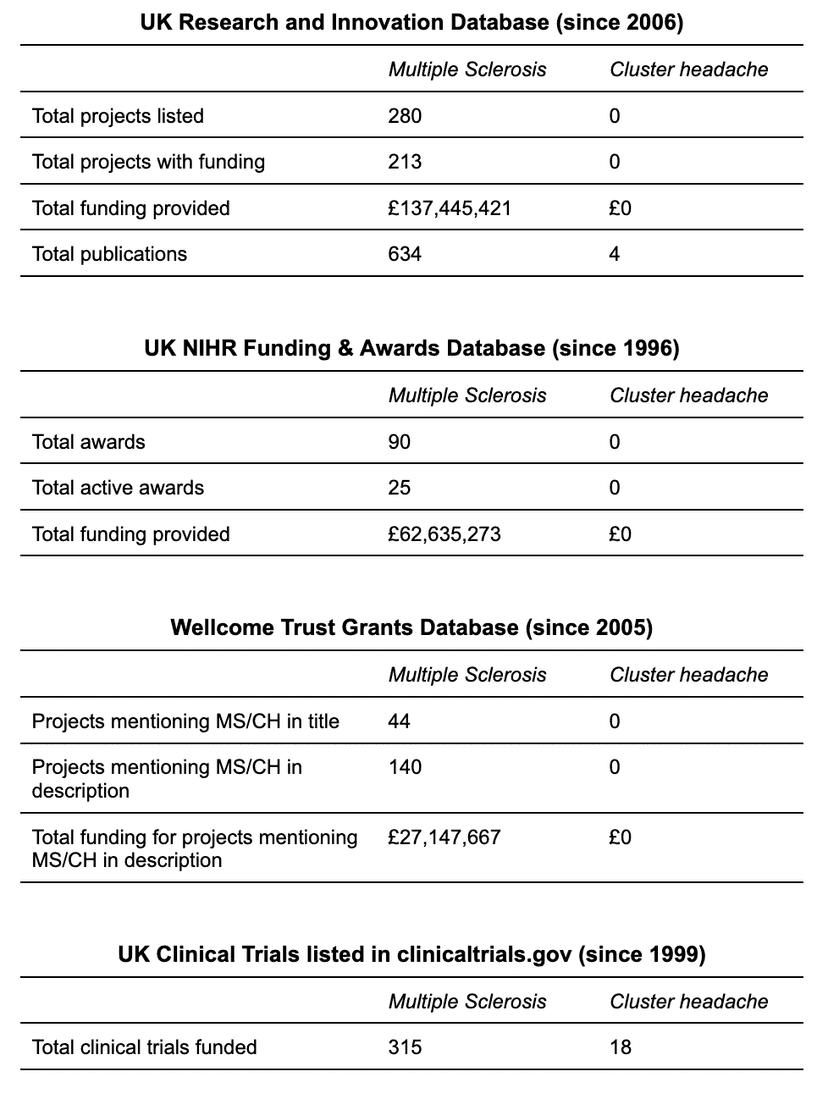
There's also virtually no funding going into cluster headache, especially relative to (a) the burden of suffering it causes and (b) investment into conditions with similar prevalence, such as multiple sclerosis. Below you can see how much R&D goes into cluster headache in the UK relative to MS (from our paper).
There are many reasons why cluster headache hasn't received the attention it deserves. If I can speculate on a few, I'd say:
- Losing a loved one to a disease can be a strong motivator to start philanthropic projects. However, cluster headache pain itself is not lethal (except when patients take their lives to escape the pain) and it does not cause visible physical disability, so it often goes unnoticed. Patients often struggle to convey the severity of the suffering to their friends and families, who may downplay the seriousness of the condition.
- It is well established that headache conditions more generally (including migraine) receive too little funding relative to the burden they cause.
- The name "headache" trivializes the condition.
- The short duration of individual attacks (15 minutes to 3 hours) may make it seem less serious than chronic conditions.
- The episodic nature of the condition (for 80–90% of patients) and its relatively low prevalence mean that it is difficult to recruit patients for trials.
As a result, any marginal resources spent on cluster headaches at this point are very valuable.
Intense suffering is intrinsically urgent
This point has been raised by others in the suffering-focused community (such as Brian Tomasik, Magnus Vinding, or Jonathan Leighton), so I'll simply quote Magnus Vinding:
Expressed in other words, one may say that the difference is that suffering, by its very nature, carries urgency, whereas the creation of happiness does not, at least not in a similar way. (Popper put it similarly: "[…] the promotion of happiness is in any case much less urgent than the rendering of help to those who suffer […]"[16]) We would rightly rush to send an ambulance to help someone who is enduring extreme suffering, yet not to boost the happiness of someone who is already happy, no matter how much we may be able to boost it. Similarly, if we had pills that could raise the happiness of those who are already doing well to the greatest heights possible, there would be no urgency in distributing these pills (to those already doing well), whereas if a single person fell to the ground in unbearable agony right before us, there would indeed be an urgency to help. Increasing the happiness of the already happy is, unlike the alleviation of extreme suffering, not an emergency.
See also: Unexpected Value: Prioritising the Urgency of Suffering by Jonathan Leighton.
Intense suffering is worse than we think
Because of the heavy-tailed valence hypothesis (or logarithmic scale of pleasure and pain), we underestimate how bad the extremes of suffering (and how good the extremes of pleasure) are—orders of magnitude more intense than mild suffering. Severe cluster headache attacks are close to the top of that scale. They are among the worst possible things a living being can experience (at least in terms of the moment-to-moment experience).
It feels sustainable
Today, in part due to a lack of moral ambition, some of the brightest minds in the world are dedicating their lives to projects that will end up not mattering in terms of the wellbeing of sentient beings: selling products nobody needs, proving theorems no one will ever use, building marginally better software tools, researching niche intellectual questions with little application. A sizeable fraction of such people will work very long hours on such projects; many will burn out.
This may sound pretentious, but I think efforts to reduce intense suffering are orders of magnitude more important than most other human endeavors. An hour of work dedicated to this goal is, I believe, far more valuable than many, many hours dedicated to an average work project. This means I don't need to work 14h days to feel like I've achieved something (not that I could, even if I wanted to; I don't have the stamina). I can work very reasonable hours and have plenty of time to exercise, spend time with friends and family, sleep, work on side projects, and do other things I enjoy.
It adds significant meaning to my life
Around 2015, I became convinced that I wanted to dedicate my life to reducing suffering, especially intense suffering. Taking the 10% pledge in 2015 and joining the Effective Altruism Foundation in 2017 (now Center on Long-Term Risk) were two important steps in my effort to align my actions with my ethical convictions. Since then, I've felt a deep sense of purpose and fulfillment in how I'm spending my precious time on this planet.
At least for now, I'm fortunate enough to be able to choose what I work on. Other areas of my life may be more difficult to control (for example, I may unexpectedly lose friends, family members, or partners) but it feels like, as long as I continue to choose to do something to reduce suffering in the world, I'll have something to fall back on. And maybe in the future I won't be able to contribute as much (though I think it's always possible to do at least something small), but I believe I'll be content with what I've done so far.
As a child, I used to wonder why I went to school. "To be able to go to university," I'd think. But why would I want that? "To be able to have a job and earn money." But why? "To be able to support a family." But why? "So that my kids could go to school." And then… the cycle would just repeat forever? Was that the whole point of life? Eventually, I realized that, if I was on my deathbed and someone asked me what I had achieved in life, I wouldn't simply want to say that I managed to have kids and thus contributed to the never-ending cycle. What if my family and I lived unhappy lives? Or what if we lived happy lives but I created more suffering in the world through my work, perhaps because I was the CEO of a tobacco company? On my deathbed, I want to be able to say that there is less suffering in the world as a result of me being on this planet. I don't know if I'll actually achieve that, but I sure will try.