Accidentally curing my impostor syndrome with low-dose MDMA
By Alfredo Parra-Hinojosa
December 26, 2025
Epistemic status: Half-baked ideas with a lot of hand-waving. I had this post sitting around for months and decided to publish it without polishing it too much and leaving out lots of detail, so it's rough around the edges here and there.
I've never been much of a talker. In group gatherings, I'm often the most quiet one. And I also rarely ever ruminate about the past, which means I very easily forget past experiences (since rumination could be thought of as a form of spaced repetition), much to the dismay of family and friends. (Classic dialog: Mom: "Do you remember the name of that café we went to when we visited Prague? The one with the waitress who insisted we speak Czech?" Me: "Wait, you and I went to Prague?!" Mom: "Ay Alfredo! :( ")
This combination of lack of practice talking and my bad episodic memory means I'm a pretty lousy story-teller. So I've come to rely on a handful of stories that reliably get a good reaction and spark interesting conversations. And one of the most effective ones I have under my sleeve is the one I'm about to tell. People's reactions to this story are usually so strong that I thought it'd be worth writing down.
Here's the gist: I believe I went from having somewhat severe, textbook impostor syndrome to full remission in one night, after combining one small dose of MDMA with some basic cognitive behavioral therapy. This happened in early 2019, and the impostor feelings that I'd been carrying with me for many years never came back after that evening in that Berlin club.
What I like about this story is that it illustrates a change that's both profound but also relatively easy to attain, in contrast to (a) the very gradual and slow change that is often experienced through psychotherapy, and (b) the very profound changes that can only be attained through very intense work (e.g., awakening as described in the Theravada tradition).
I still don't fully understand how such changes can happen (I don't think anybody really does). But in this post I'll share some very speculative ideas about how optical holography could offer an explanatory lens.
Obligatory disclaimer: MDMA is illegal in most (all?) countries and its neurotoxicity effects are not fully understood (though likely overblown). But if you plan to take it anyway, at least take some basic safety precautions, please.
The qualia
The term "impostor syndrome" has almost become synonymous with "merely" feeling inadequate or insecure (usually at work). However, the actual syndrome refers to some very specific qualia that go beyond just feeling inadequate, namely:
- Active deception: You feel like you're deceiving your colleagues by making up for your obvious incompetence in other ways (e.g. by working extra hard or getting extra help). But if they really knew how your mind actually works, they'd be shocked and would fire you right away.
- Low-key paranoia/hypervigilance: Since you don't want to be discovered, you're constantly ultra preoccupied with what others might think about you, and you find all sorts of ways to continue to keep them in the dark.
- Success paradox: The more you achieve, the more convinced you become that you're fooling everyone. Each accomplishment feels like evidence that you're getting away with something rather than proof of competence.
- Attribution distortion: This is related to but different from active deception: All your successes get explained away through external factors (e.g. luck, timing, easy circumstances) while failures feel like true reflections of your abilities. You develop an almost allergic reaction to taking credit.
There's more to impostor syndrome, but these factors stand out to me most (especially the first one). I emphasize this not to be pedantic or to downplay the experiences of people who feel insecure at work, but because the distinction actually matters for this post: Even after I got rid of my impostor syndrome, I still experienced moments of high anxiety, insecurity, etc. But the quality of that anxiety was decidedly not impostor-like. Eliminating anxiety altogether might require more radical approaches…
I suggest the "jaw-dropping test" as a way to tell whether the thing you're struggling with is impostor syndrome or not: if, the first time you read the characteristic traits of impostor syndrome, your jaw drops in disbelief at how accurately your experience is being described, then yeah, you probably have impostor syndrome. This sure happened to me the first time I read my first book on impostor syndrome (this 100-page one, which I continue to recommend to others struggling).
I also ticked lots of the boxes predisposing me to imposter syndrome:
- Being the first at various things at home (e.g. first one in my family to study abroad and get a PhD)
- Being atypical in my field (e.g. working in business operations while having a PhD in computer science)
- As a child, being rewarded for outcomes rather than effort, leading to perfectionism
- Growing up with extremely high expectations from others
- Working in highly competitive environments with super competent and smart people
The context
While I probably developed impostor syndrome in college (around 2006), it reached its peak in early 2019 while working full time in operations at an EA organization. This felt like my first real job with real stakes (unlike my PhD, which interestingly was very manageable impostor-wise). It was a tough job, but back then I kept thinking "come on, this isn't rocket science; especially compared to doing a PhD in computer science!". Creating budget spreadsheets, running payroll, organizing conferences. Should be easy! But it definitely was not.
I'll spare you the details, since you can probably piece together how I must have felt. It was tough!
And it was kind of crazy: I had the nicest, most supportive colleagues (who were very happy with my work, and constantly told me so), great working conditions, a meaningful mission, etc. And yet, I was often plagued with impostor thoughts that simply did not reflect my reality at all. Looking back at my journal entries from that time, this Mark Twain quote comes to mind:
My life has been filled with terrible misfortunes, most of which never happened.
By early 2019, I was fully aware of my impostor syndrome and had been doing some self-directed CBT bibliotherapy, mostly the triple column technique. Here's a (made up) example:
| Automatic thought | Cognitive distortion(s) | Rational response |
|---|---|---|
| The meeting agenda I prepared missed an important item, which caused the meeting to extend for longer than planned. I must be bad at tasks requiring attention to detail. | Overgeneralization; Disqualifying the positive | I was given very little time to prepare, so naturally some things would fall through the crack. My colleagues seem to have otherwise been happy with how the meeting went. And most meetings I organize go flawlessly. |
I felt like I was making some progress with my impostor syndrome, but the "rational responses" often didn't quite feel very real. It felt more like I was trying to convince myself of something that I didn't believe in my bones. This was about to change.
The intervention
On the night of Friday, February 22, 2019 I was out with friends at this club in Berlin, trying really hard to just enjoy myself. The music was awesome (exactly my type of music), my friends were in a great mood, and the vibes were ✨immaculate ✨.
But my efforts to relax and have a good time were frustrated by intrusive impostor thoughts triggered by something that happened earlier that day at work (I basically got some minor critical feedback on how I moderated a team meeting). I just couldn't stop thinking about it.
And then, at some point, one of my friends randomly offered me a finger-dip1 of MDMA. Against my best judgment (never take drugs on a whim, always know exactly how much you're taking, make sure you take the right supplements, make sure you're in a positive mindset, etc.), I went for it. Obviously, DO NOT FOLLOW MY EXAMPLE. It was reckless of me. (Later, I'll share alternative strategies that don't involve taking any illegal substances.)
So anyway, I start coming up on the MDMA, I'm dancing, I'm vibing, and… my colleague's feedback intrudes yet again. "Come ON," I think to myself, "this is insane! Give me a break. I'm just trying to have some fun here!" And so I decide to pull out my phone and do some triple column-style self therapy, because why not. I knew that writing things down could sometimes help. It was mostly just stream-of-thought rational responses from the triple-column technique; things like: "It's OK for me to make mistakes sometimes; it happens to everyone. I'm not immune to it no matter how hard I try."
And suddenly, it all clicked. For the first time, I actually believed deep in my bones the things I was typing. I suddenly felt an intense wave of energy flowing through my body as I had this realization. It truly is totally fine to make mistakes once in a while! I'm imperfect and that's fine and normal! I'm probably still quite smart and competent! I felt an enormous release of tension, and I was ecstatic. My colleague's feedback was not a big deal anymore.
I went back to the dance floor with my friends and had an incredibly fun night without any intrusive thoughts. More remarkably, the shift was permanent and the impostor feelings never came back.
The (speculative) explanation(s)
What exactly happened in my brain? I'm not quite sure. But about one year later I came across an explanation that resonated a lot with what I experienced: memory reconsolidation. I must have come across the idea either through Kaj Sotala's summary of the book "Unlocking the Emotional Brain" (the seminal book on memory reconsolidation) or Scott Alexander's review of that same book. I got myself a copy of the book and I couldn't put it down.
I encourage you to read at least one of the two reviews above to understand the whole memory reconsolidation / coherence therapy deal, but the core claims of the book (in extremely simplified terms) are:
- Deep down, lots of different psychotherapy techniques do the same (when they succeed at permanently changing a belief or behavior): they completely erase the old, maladaptive pattern and substitute it with a healthier one.
- However, existing psychotherapy techniques usually get there serendipitously. As the authors put it:
What we therapists find most fulfilling are those pivotal sessions in which a client experiences a deeply felt shift that dispels longstanding negative emotional patterns and symptoms. Bringing about such decisive, liberating results for our clients sustains us, but the alchemy that produces these life-changing shifts has been something of a mystery, allowing them to come about only unpredictably in the course of many months or years of sessions.
- There is a technique that reliably triggers such deep changes directly—no need to talk endlessly about your relationship with your mother or to scream your childhood trauma away.
- In fact, the authors argue that most therapeutic techniques aim to only counteract the symptoms without actually permanently removing their root, which causes the symptoms to still be triggered under certain circumstances (though perhaps less intensely). So the series of events "colleague gives me negative feedback → I freak out → I remind myself it's fine because x, y, z → I feel fine" instead becomes "colleague gives me negative feedback → I feel fine". No symptom is triggered at all. This is kind of how I felt about CBT before my permanent shift: helpful for coping, but it didn't get rid of the problem at the root.
Indelibility implied also that the only possible psychotherapeutic strategy for preventing symptoms based in emotional memory was the use of counteractive methods—the class of methods (including extinction training prototypically) that compete against an unwanted learning by building up a preferred learning and response intended to override and suppress the unwanted response. The unwanted response remains relatively free to recur, so an ongoing counteractive effort is typically required indefinitely. […] The strategy of counteracting predominates in the psychotherapy field and is carried out by a wide range of methods, such as the various forms of cognitive-behavioral therapy (CBT), solution-focused therapy, and the positive therapies.
- The technique involves (roughly) these steps:
- First, trigger the specific maladaptive belief and experience it vividly in your mind (e.g. "If I speak up at work, my colleagues will think I'm an overconfident jerk.")
- Then, you try to come up with evidence that contradicts your belief (the "juxtaposition experience"), and you try to experience it vividly as possible (e.g. "Actually, this other colleague usually speaks up confidently but respectfully, and everybody likes him. Like during last Friday's meeting!")
- Try to hold both beliefs in your mind simultaneously. Notice how they can't both be true simultaneously. Keep doing it until your brain gives up and decides to abandon the maladaptive belief for good.
- Feel an ecstatic wave of release. You may cry and laugh. But maybe wait a bit, and then triple-check that the old belief is actually gone for good. If successful, you may then have thoughts such as "Wow, how could I have even believed X for so many years?! What was I thinking? Silly me!"
These are, needless to say, very bold claims, and the authors make sure not to undersell them. As Scott Alexander put it:
And then Richard was instantly cured, and never had any problems speaking up at work again. His coworkers all applauded, and became psychotherapists that very day. An eagle named "Psychodynamic Approach" flew into the clinic and perched atop the APA logo and shed a single tear. Coherence Therapy: Practice Manual And Training Guide was read several times, and God Himself showed up and enacted PsyD prescribing across the country. All the cognitive-behavioralists died of schizophrenia and were thrown in the lake of fire for all eternity.
(And yet, despite the satirical tone, Scott doesn't seem to disagree with the actual claims per se?)
Overall, I find the basic idea and the technique quite compelling. And given my growing interest in understanding consciousness at a mechanistic level, I can't help but wonder what might be going on under the hood. However, I don't find the mechanistic explanation offered in the book particularly compelling, which is based on a very traditional picture of the brain (the neuron-doctrine). They suggest that, deep down, memory reconsolidation involves a biochemical "unlocking" of the synapses (basically, becoming temporarily more plastic). This unlocking happens somehow when the old memory is retrieved and a new, mismatching belief is introduced. This opens a window of opportunity for the new belief to replace the old one.
This (admittedly oversimplified) explanation may sound plausible, but, when I look closer, I don't think it really is an explanation. How do the synapses know to "unlock" exactly when both the old memory and the mismatched belief are introduced? Why does memory reconsolidation result in feelings of ecstasy? More generally: How exactly is it that synapses encode specific memories? And how can synaptic firing generate actual images in one's mind's eye (at least for those of us who don't suffer from aphantasia)?
On the other hand, I believe our understanding of how memories work is still in its infancy, so Ecker and colleagues have to work with what they got. For instance, Nishiyama et al. point out some reasons why we might be skeptical of long-term potentiation (LTP) as the primary mechanism for storing short- and long-term memories:
First, while long-term memory endures, LTP does not make permanent changes to synaptic strength but decays over hours to months. Second, LTP-based memory models suffer from the loss of signal fidelity. Third, memory requires the assimilation of information across different sensory inputs involving huge neural circuits that need to be somehow integrated. Finally, external stimuli are associated within their context, so that new experiences are influenced by the current context, previous experiences, and even anticipation of the future. To explain this with only synaptic-based computing may easily exceed the capabilities of the brain. This suggests that another level of computation in the brain is needed for learning and memory functions.
They also point out a few important ways in which human memory is clearly distinct from computer memory:
We recall a song or a melody in the forward direction, not backward, (sequential patterns). When part of information is given, we recall the whole memory auto-associatively (auto-associative recalling). Memory is processed in a hierarchy in the neocortex, namely in regions V1, V2, ···, V5, for visual processing (storage in a hierarchy). Memory is stored in patterns in an invariant form. In taking a cup and drinking tea, all motions are different each time, but we recognize them as a single movement. Memory has diffused nonlocal features and is not localized in a particular region of the brain [9]. Even if part of a brain is damaged, memory is recalled by remaining undamaged areas [10], which is known as equipotentiality [11]. Whether or not particular memory is lost depends on the magnitude of widespread lesions in the brain, known as the mass action principle [9]. Memory is robust against damages done to the brain.
Admittedly, I'm not a neuroscientist myself (my neuroscience qualifications are: I took an introductory online course, read some papers, and, um, watched a lot of YouTube videos), but I think I've gotten better at telling when an explanation isn't really an explanation (shout-out to David Deutsch's wonderful book "The Beginning of Infinity"—great for anyone who's into explanations). And neuroscience / consciousness studies are replete with pseudo-explanations once you start paying close attention. (For example, calling a brain region a "pleasure center" because its activation is merely correlated with feeling good is not an explanation. The same goes with calling serotonin the "happiness" molecule or dopamine the "pleasure" molecule. Mike Johnson's Symmetry Theory of Valence, on the other hand, gets much closer to a satisfying explanation of what a pleasure center actually is.)
This is all to say that I'm just not satisfied with how standard neuroscience and psychotherapy attempt to explain what happened to me on that night of 2019, so I'm compelled to look elsewhere.
Holographic models
Recently, I've been getting a lot of mileage out of thinking of consciousness in terms of holograms. In a previous post, I used a simpler analogy of the brain as a projector that creates a ~3D2 replica of the outside world inside your head, and claimed that this replica is an actual, physical thing being instantiated inside your brain, probably as a standing pattern of nonlinear electromagnetic waves. In this picture, what (at least some) neurons do is generate and modulate electromagnetic waves in just the right way to sustain the replica. In this picture, neurotransmitters modulate the permittivity of neurons, causing the waves to travel in different ways, as suggested by QRI's Brain as a Non-linear Optical Computer (BAANLOC) model.
The projector analogy is mostly an intuition pump (though we might end up finding surprising parallels between the brain and liquid crystal display projectors). In particular, standard projectors shine light carrying only intensity and color information to produce a 2D image (notably, there's no information about the phase). Our conscious experience seems much richer. Holograms might come closer to replicating some of the characteristics of our moment to moment experience (and our memories).
Cube Flipper recently published a post titled "Is consciousness holographic?", which I can't recommend enough. It starts with an overview of 3Blue1Brown's amazing video "How are holograms possible?" and goes on to discuss the history behind holographic approaches to consciousness, adding lots of new tentative ideas. Do check it out!
Important for our current discussion is the idea that not only might our moment to moment conscious experience be holographic, but also that memories could be stored according to holographic principles. For example, according to Westlake's model, the brain may support the three ingredients needed to generate, store, and retrieve holograms:
- The equivalent of the reference wave is a synchronized plane wave of neural spiking arriving at synaptic junctions with uniform timing.
- The equivalent of the object wave is a wave of neural spiking emanating from sensory object source points, with timing that depends on the distance traveled.
- The equivalent of the holographic plate is the array of synaptic junctions where these waves interfere through spatial summation, creating a distributed pattern of neuronal firing that encodes the interference pattern with changes to synaptic connection strengths.
Then, when the original reference wave is presented again to the distributed pattern of synaptic connections that recorded the original interference pattern, these would interact in such a way as to reconstruct the original object wave – and so unfolds our holographic memory system. The reference wave could then be modified in order to access different memories.
Whether this is the exact mechanism at play is still unclear, but it gives us a sense of what a holographic solution to memory storage and retrieval could look like.
What's not addressed above is how a memory can get erased entirely and be substituted by a new one, which is the core element of memory reconsolidation. If we take the holographic approach seriously, we can ask: how do holograms get erased in optical systems, and might the brain support analogous mechanisms?
To answer that question, we first have to ask what kind of holographic substrate the brain might be, since holograms can be created on a wide range of materials (such as photographic emulsions or photopolymers). One candidate could be some sort of organic photorefractive material, since such materials are particularly valuable for dynamic holography, where one can write, erase, and rewrite holograms in real-time. Organic photorefractive materials are also compelling for other reasons:
- Their mechanism of action is a nonlinear optical effect (the photorefractive effect), which ticks the box of QRI's BAANLOC framework (see also: Nonlinear Wave Computing).
- They can be used to perform logical operations (OR, AND, NOT, NOR, XOR).
- They can be used as a tunable color filter, which "could be used for filter channels, optical attenuators, and optical color filters." Maybe these are the sorts of elements required to build Andrés's nonlinear optical circuit?
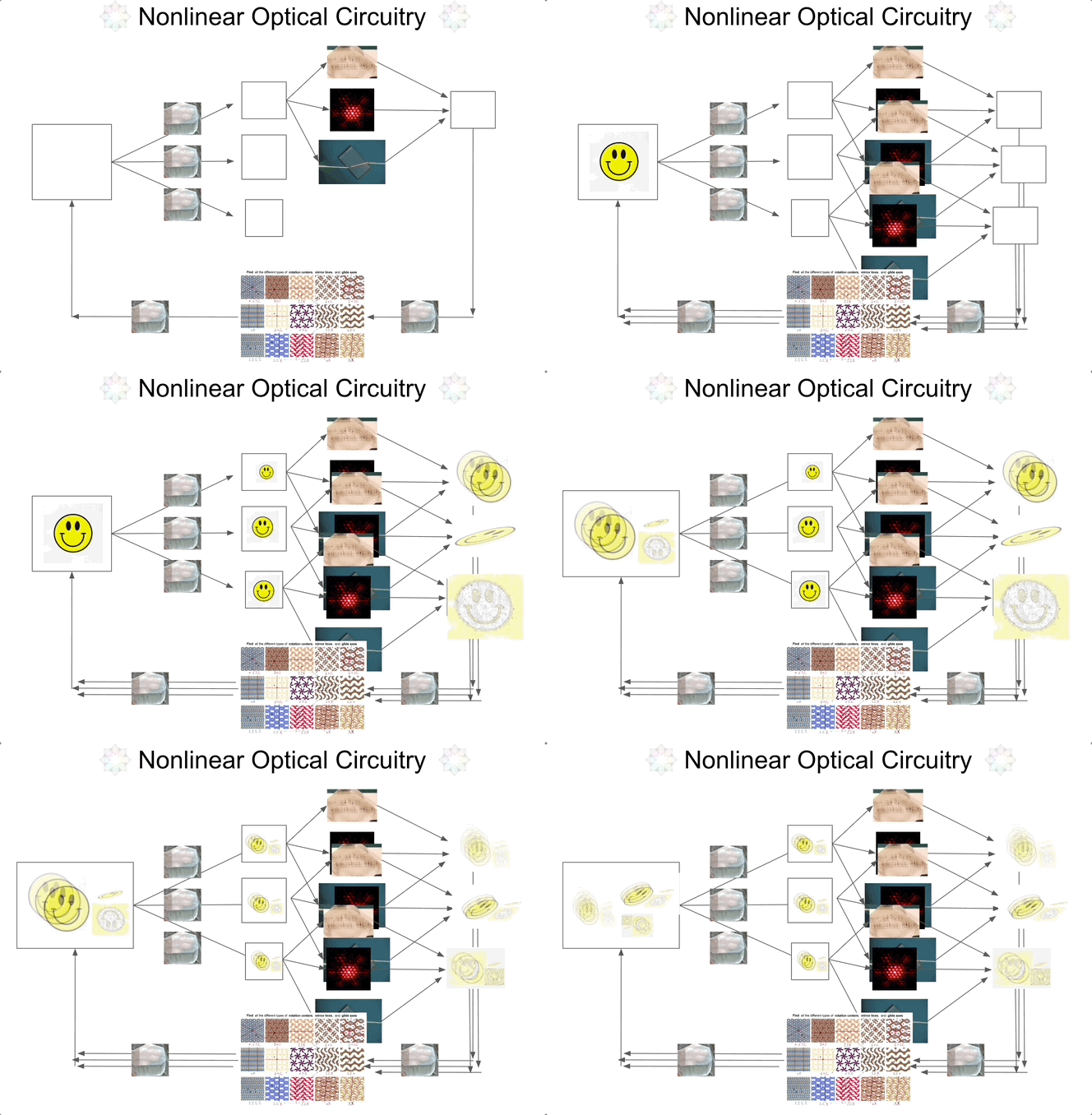
My understanding of the literature is that the most common way to erase a hologram recorded on an organic photorefractive material is by illuminating the entire holographic plate with incoherent light at the material's sensitive wavelength. From Blanche et al.:
To erase the hologram, a homogeneous beam is used to illuminate the material, exciting the charges that were trapped in potential wells. These mobile charges recombine, canceling the space-charge electric field. In the absence of a space-charge field, the chromophore molecules are free to reorient themselves due to thermal agitation, and the index of refraction returns to an average value. The material is now ready to record a new hologram, eventually different from the first one. This process can be repeated indefinitely since the material does not endure any fatigue during charge generation or molecular orientation.
I'm not sure how such a homogenous illumination could be implemented in the brain. But another erasure technique caught my attention: the π-phase-shift method (described e.g. in Aguilar et al.).
The motivation behind π-shift erasure is that using incoherent light alone can result in all holograms in the plate being erased. The π-shift method allows for selective erasure of specific holograms, leaving others unchanged. So selective erasure is an active process that involves writing a new hologram directly on top of the one targeted for erasure. This seems like a desirable feature for memory erasure.
In very simple terms, this erasure method involves:
- A recorded hologram, which is a space-charge field grating recorded in the refractive index of a medium (e.g. a LiNbO3 crystal).
- Illuminating the recorded grating with a coherent reference beam to reconstruct the object beam.
- A second, phase-shifted light interference pattern used for erasure. Destructive interference between the original and the new phase-shifted grating reduces the amplitude of the original hologram to zero.
Mathematically, the process is described as follows:
,
where the grating field , being the amplitude and the phase mismatch with regard to the initial light pattern. captures the decay rate and phase drift velocity of the original hologram. The equation therefore describes the decay of the original hologram (the first term) and the growth of the new pattern (the second term). The authors show that, when the phase difference between the two terms , the erasure rate is maximized.
π-shift erasure caught my attention because the juxtaposition experience used in memory reconsolidation sounds a lot like it could correspond to a π-shifted interference pattern relative to the maladaptive pattern. This is where things get very hand-wavy but, for example, if the maladaptive pattern is "If I speak up at work, my colleagues will think I'm an overconfident jerk," then maybe the target pattern "If I speak up at work, my colleagues will not think I'm an overconfident jerk" could be interpreted as a π-shifted version of the maladaptive pattern.
Putting it all together:
| Phenomenon | Coherence Therapy (Psychological) | Holonomic Brain (Neurophysical) | Photorefractive Erasure (Optical Analogue) |
|---|---|---|---|
| Memory Storage | An implicit emotional learning or schema, a coherent model of reality. | A distributed interference pattern (hologram) stored in a matrix of synaptic weights. | A space-charge field grating recorded in the refractive index of a medium. |
| Memory Reactivation | Experientially accessing the target schema, bringing it into conscious awareness. | Illuminating the neural hologram with a coherent reference beam (a specific pattern of neural oscillation) to reconstruct the pattern. | Illuminating the recorded grating with a coherent reference beam to reconstruct the object beam. |
| Erasure Trigger | The "juxtaposition experience" creating a "prediction error" or "mismatch experience". | A new, contradictory sensory input generating a second neural interference pattern that is out of phase with the original. | A second, phase-shifted light interference pattern is introduced. |
| Erasure Mechanism | The brain's innate reconsolidation process nullifies the original neural circuit's encoding. | Destructive interference between the original and the new holographic pattern, leading to a nullification of the synaptic weight pattern (LTD). | Destructive interference between the original and the new (pi-shifted) grating, reducing its amplitude to zero. |
| Outcome | The emotional learning is permanently erased; the autobiographical memory remains. | The specific interference pattern is nullified, erasing the "deep structure" engram while leaving the "surface structure" circuit intact. | The recorded grating is selectively erased, leaving other multiplexed holograms unaffected. |
This holographic picture of memory erasure seems to fit other observations from psychotherapeutic work, namely:
- State-matching matters for efficacy: Interventions that better match the original encoding state should produce more complete erasure. This might explain why body-based and somatic therapies are better for trauma release than purely cognitive approaches.
- Optimal "phase" varies by individual and trauma type: There may be no universal juxtaposition experience. The ideal contradictory input depends on the specific parameters of how the original pattern was encoded. The therapeutic intervention needs to be personalized.
- Complex trauma may require a multi-pass approach: π-shift erasure works straightforwardly when applied to so-called "short-time recordings" (holograms recorded for a duration that is short compared to the time required for the grating to reach its maximum possible strength, or saturation). Short-term recordings may correspond to simpler memory patterns or single-event traumas, whereas more complex trauma may correspond rather to saturated holograms for which a simple π shift is insufficient. For such cases, it may be necessary to "illuminate" and juxtapose the memory from various angles and for more extended periods of time (analogous to how MDMA therapy requires accessing the same core memory but through different angles each time).
- Incomplete erasure leaves traces: If the phase matching is imperfect, symptoms may be partially reduced but not eliminated, which is observed in many treatment outcomes.
Conclusions and open questions
It's quite likely that the holographic principles I've outlined here are not implicated at all in memory reconsolidation. But I genuinely believe that current neuroscientific explanations aren't satisfying either, since they are largely descriptions of correlations, as Mike Johnson has argued. We need physics-based models that can account for phenomena like memory reconsolidation at a deeper level (not to mention the vast space of exotic phenomena that mainstream neuroscience hasn't even begun to explore).
Obviously, MDMA is not necessary for memory reconsolidation (it happens all the time in the therapy room without any drugs). But other practices that increase the energy parameter of one's consciousness could also help accelerate the process (cf. neural annealing: 1, 2), such as breathwork, meditation, exercise, and psychedelics.
I'll finish with a few open questions on my mind:
- How exactly might the reference and object beams be implemented in the brain? For example, we know that hologram storage density is maximized when the beams are perpendicular to each other. Do certain areas of the brain display this perpendicularity? What other geometric features of the brain could support the elements of a holographic setup? (Cf. some recent work by Cavaglià et al.)
- Could we describe the various beams in terms of waves arising from coupling kernel dynamics?
- Hologram erasure can generally be sped up by heating the plate (or applying an external electric field). Is that the primary way in which MDMA or other energizing interventions facilitate memory erasure?
- So far we've talked about holograms created using classical optics only. But if entanglement is implicated in phenomenal binding (cf. Barkai 2018), should entanglement somehow appear in the holographic setup? Could the brain be implementing quantum holography instead?
- The moment a pattern is erased through memory reconsolidation usually causes feelings of ecstasy. Does the Symmetry Theory of Valence predict that?
- Could one use something like trans-cranial alternating current stimulation (tACS) to generate π-shifted oscillations of a recorded engram? (Cf. "patternceuticals")
- Could memory reconsolidation occur even more efficiently in hyperbolic (phenomenal) space?
Footnotes
-
Basically, you lick the tip of your pinky finger and dip it into a little bag containing the substance, and you just ingest the small amount that sticks to the tip. If done "right," this extremely crude measuring technique is supposed to result in a small dose (maybe ~50 mg? But it depends a lot on the batch). ↩
-
Different experiential fields may have different dimensions—the visual field being 2 or 2.5D and the somatic field being 3D. Andrés talks about this in the context of Projective Intelligence. ↩